Years ago, the initial trailer for Luto immediately had me excited. The studio masterfully incorporated numerous terrifying horror elements into an early, albeit rough, build of the game, but even that brief clip was enough to showcase genuine fear. With its dark hallways, menacing ghosts, and disorienting environments, what wasn’t there to love? I was instantly excited to learn more about the game. But something changed.
In 2023, the studio followed up with a demo that, for me, instantly sold the game. It was arguably the best horror experience of that year, feeling almost complete and delivering fantastic levels of horror. I believed we were on the verge of another Visage-level title, but with more polish. The demo had everything: it was scary, it left me wanting more, and I was ready to throw money at the screen to keep playing.
Luto
Developed by: Broken Bird Games
Platform: PC, PlayStation 5, Xbox Series X/S
Release Date: July 22, 2025
My enthusiasm for Luto may have led to disappointment, as the final product doesn’t match the game I was led to expect. During the initial hype phase, my sole desire was to be genuinely terrified. I wanted a game that would have me set down the controller and step away, similar to my experiences with MADiSON, or create a reluctance to even walk down a hallway, much like Visage.
Luto presents a unique take on horror instead, where fear is more of an illusion. The game constantly teases a scare that never truly materializes, leaving players to question their own reactions. While beautifully crafted, Luto’s effectiveness as a horror game lies in its ability to make players jump at loud noises or react to outright jump scares, despite the absence of any genuine threat or reason to be afraid. Ultimately, the game concludes with the realization that the fear you experienced was self-imposed, as “nothing truly happens.”

Having just completed the game, I’m left feeling a little disappointed. After years of anticipation fueled by a truly terrifying trailer and one of the most frightening demos I’ve ever played, I played the full experience without breaking a sweat. I can’t help but wonder why.
It boils down to a change in direction with the final game. The demo provided no clear guidance or calming elements, leaving players to discover things independently. However, the final game introduces a narrator, abruptly changing the overall experience entirely. You feel safe simply because you know nothing will happen while he’s talking. It takes away an entire aspect of fear itself. And while you could argue the narrator becomes an incredible part of the story later on, it doesn’t make up for the fact he makes the game less scary.
Slight spoilers ahead, skip to the end if you don’t want them.

The narrator in Luto occasionally shatters the fourth wall, creating truly epic and terrifying moments. These instances, where the narrator comments on your mistakes, makes snide remarks about you pausing, or even threatens to take over the controls, are far more frightening than any ghost wandering the empty halls. This suggests an intriguing alternative: Luto could be re-imagined as a psychological thriller.
On PS5 you have the opportunity to mess with the triggers on the controllers. Or you could pull a full Metal Gear Solid and read some game saves. But sadly nothing beyond a few creepy sequences take place. The game instead does a terrific job of just outright making you feel uncomfortable in many sequences. Spooky sounds, dramatic environments, and potentially a wiener shadow oddly close to you (?) while you watch a security tape all pivot the story forward, while making you question what the fuck is happening. There are also multiple sequences where the game utilizes its forced widescreen black bars to enhance the uncomfortable feeling.
But instead of truly exploring these themes, the game takes a completely different turn, delving into the realm of horror games from an outside perspective. It’s unclear where the concept originates, but halfway through, the game intentionally glitches, revealing development tools you would see while making a game, like spots that would trigger in-game events, or out of bounds zones, and scripted events. There are even developer notes, and scripted dialogue. This completely strips away any horror, transforming it into a game that ultimately satirizes other horror games and even itself.
Despite all this, it was still an enjoyable and trippy experience. The developers expertly manipulated various elements, from screen glitches and visible scripts to triggered events and audio distortions. Later in the game, they even poked fun at themselves with “cut content” and jokes about the game’s direction. These moments offer the only glimpses of aspects seen in early trailers and demos, like ghosts grabbing you or levitating.
It just wasn’t an expected twist, and not the same game I signed up for.

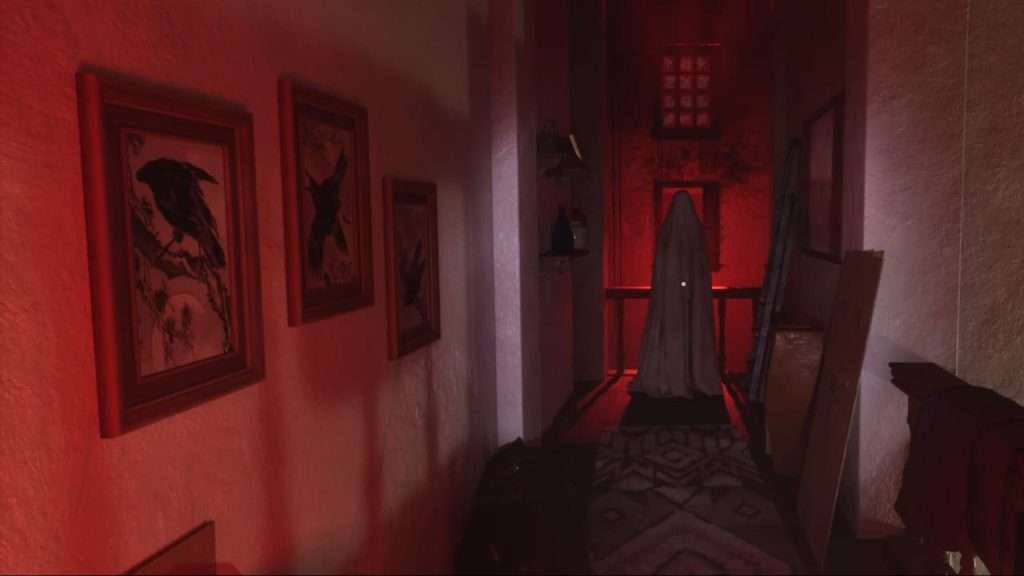
It’s disappointing because Luto does everything incredibly well up to this point. The world you’re thrown into is full of secrets, puzzles, and realistically draped ghosts that haunt your every move. The game itself is beautiful from the get go. It is eerily realistic, and the details put into the sound enhance the realism to a point of it just feeling uneasy that something is going to happen at any moment. Situations you’re placed into have just enough visual clarity to hide something in darkness around you. There are moments where you can watch a TV, and instead of watching it directly head on you watch it from an angle so you can see lights and movement off to the side, and feel a little helpless. The few jumpscares the game offered legitimately spooked me, like when a door closed and a ghost ran directly at me. It feels real, and it made no sense to me to upend what was easily turning out to be one of the best horror games, to make a satirical twist instead.
Again, it isn’t bad, it’s just not what we were sold.
I have to highlight the puzzles though because they are so intricate and probably some of the toughest puzzles I’ve worked with. The game doesn’t simply have visual clues, it instead utilzes the entire inventory at hand. There are signs and pictures that all blend into the environment, and it’s extremely easy to overlook. Items you pick up could lead to figuring out a clue later on. And the narrator will even have slight hints with the words he says to you.
But it’s also the complexity of these puzzles that led to the horror aspect being non-existent. In one case there was something trying to open a door, slamming against it and twisting the handle, and at first you feel an overwhelming sense of doom if you don’t figure out the ongoing puzzle quickly. However due to the complex nature of the puzzles, it doesn’t go by very quickly and you realize the person is never coming in and you’re in no real danger. I will say some puzzles had me frustrated at times because to solve them made no real sense, you kind of just accidentally did it, like calling a phone number 3 times.
In the same sense the game has no guidance on where to go at any moment. This led to several moments of wandering aimlessly into darkness, or open ended areas, because I didn’t walk the exact line as intended. In many moments the game is disorienting simply because you’re hunting for clues that don’t exist.
The game does a brilliant job with the loop system, however, which is so common in horror games now, thanks to PT, by not simply making you walk through endless doors. It instead finds creative ways to always put you back at the starting point, and it physically drives you insane at times by making you curious how it happened. I was really impressed with the various ways you end up back at square one, but also how every cycle felt completely different even though you were walking the same hallway. The narrator even comments on your sanity when you mess up and end up at square one a few too many times.
Ultimately this is how the game tells the story. It’s a game about death. It dives into very intense mental issues, but ultimately it’s about accepting death and trying to move on. When you realize this, then the loop system and mind altering events make a lot more sense.
But after completing the game, I was left with more questions than answers. While some fundamental questions, such as the identity of the narrator, were eventually addressed, the overall plot remained perplexing. Despite uncovering every clue and piece of readable exposition, I struggled to understand the characters’ roles and the core conflict. Even after exploring the creatively designed secret level, implemented in a way to deter speedrunning, it offered additional insights, and yet still left me scratching my head because it was just more confusion. The core game itself also doesn’t do a lot of explaining, so if you’re not hunting down the notes you will never understand anything.
The game itself offers a very powerful message when dealing with death. The idea of questioning yourself, asking if you could have done something different, and the narrator even progressing through the game. I felt it was a good twist to horror storytelling to be going through emotions of a character dealing with this mental state, not so much a character that necessarily did anything wrong. They also do a good job of working with rational fears, like spiders and darkness, to make you entirely uncomfortable as a player.
But the game seems to clearly have suffered from excessive cuts and a complete shift in direction, which negatively impacted the storytelling. Key narrative elements felt rushed and underdeveloped. While glimpses of deeper lore and visual metaphors appear sporadically, the overarching themes are never fully solidified due to a lack of clarity. The game also has long moments of nothing happening for no real reason. I thought it was to build up some tense moments, but nothing came from my long ladder climbs or 5 minute dive into a hole. The story felt like it was missing key moments to explain the impact of the situations at hand. And honestly I was excited to be afraid of simple white cloth ghosts again, but even their ghostly scares were toned down.
Overall it just felt like the direction went from a dark horror filled titled, and shifted into a more comedic tone. Perhaps that is acceptance of death, moving on, and is metaphorical in a sense, but the interpretation is up to you. The overall message about ghosts, and the short poem style quote, that follows you throughout the game, is terrific and becomes the most impactful moment in the game that sends home a message that you will remember.