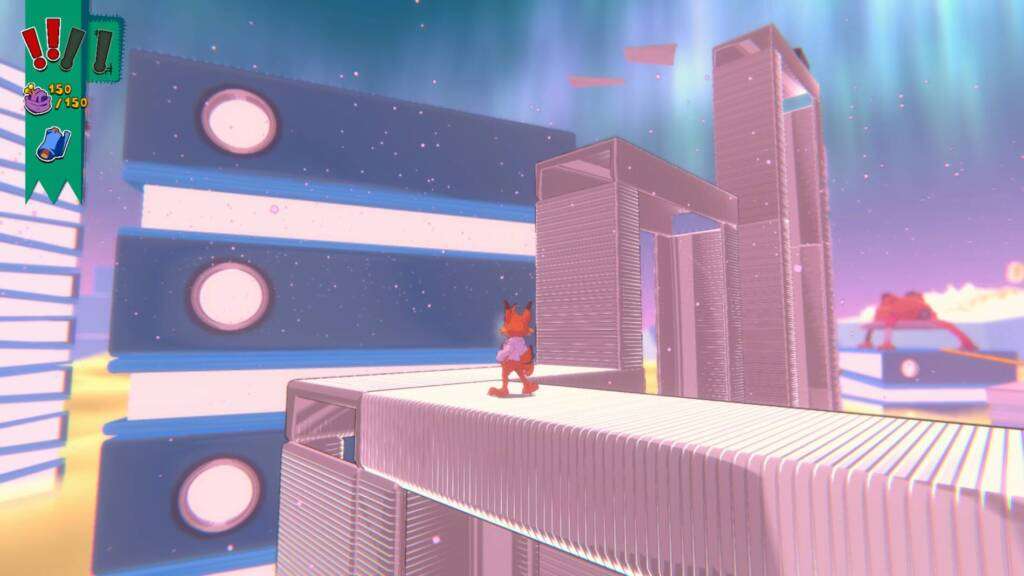

Atari shocked the world at Gamescom last year when they dropped a trailer for a new game featuring, of all things, Bubsy the Bobcat, a “classic” platforming mascot from the 16-bit era with a series of games that were, at best, the kind of rental fodder that populated the gaming landscape of that time and culminated with Bubsy 3D, a disastrous transition to three-dimensional gaming that was resoundingly criticized and buried the bobcat. Now, Atari’s teaming with indie developer darling Fabraz to revitalize the shirt-clad cat with a new three-dimensional platformer, appropriately (I suppose) titled Bubsy 4D.
Bubsy 4D
Developer: Fabraz
Platform: PC, Playstation 4&5, Xbox One, Xbox Series X|S, Nintendo Switch/Switch 2 (Reviewed on PS5)
Release Date: 5/22/2026
While this new game won’t be everyone’s cup of tea, hiring a competent developer leads to a game that actually is worth playing and keeps people returning. Bubsy 4D is far from perfect, but it could easily stand in conversation as one of the better platforming games in recent memory.
Pouncing Around Never Felt So Good
What really drives Bubsy 4D forward is the precision of its game mechanics. Fabraz rarely misses when it comes to designing interesting ways to maneuver your character through a level, and this game proves no exception. The core motion concept centers around three “speeds,” so to speak: Bubsy can walk on two legs, run on all fours, or engage in “Hairball Mode” where he, like the Hedgehog whose popularity he was designed to cash in on, tucks himself into a rolling ball for maximum speediness. With every increase to speed, however, comes a decrease in maneuverability: Bubsy can still move pretty precisely on all fours, but when rolling at top speed, it’s all you can do to point him in the right direction and pray.
What makes this work is the ease in which you can swap in and out of these speeds, Hairball Mode specifically. It takes a bit of getting used to, but you are able to perform very complex maneuvers by utilizing your jumping tools (a double jump, a glide, and a “pounce” that serves as a dash) in proper orders after first getting a speed boost with Hairball Mode. It all feels really good, even if it sometimes can be a little hard to get a handle on Bubsy at his fastest. If anything, the game makes an impressive effort of maintaining the feeling of unchecked momentum from the original games, while actually making you more fully in control of your moves than ever.
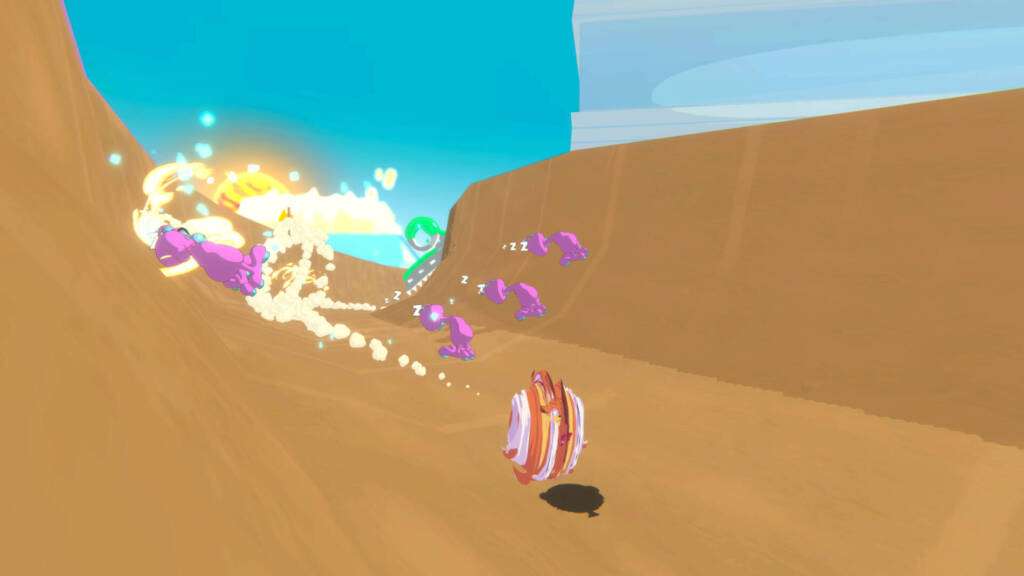
With great maneuverability, one would hope for great places to play with it, and Bubsy 4D does stumble here, at least to some degree. The earlier stages are fairly short, and the later ones positioned over deadly water or bottomless gaps for approximately 80% of the stage, meaning that when you begin, you’ll never get a chance to let Hairball Mode truly rip before the level ends, and when you’re almost through, you’re rarely getting a chance either because of all the precision platforming required. Many stages have at least one flat zone or specific Hairball section to zoom through, at least, and usually one big platforming super-section for locating the most hidden collectibles. Design-wise, the stages are perhaps on the weaker end, but are largely entertaining to navigate all the same.
Style That Matches Substance
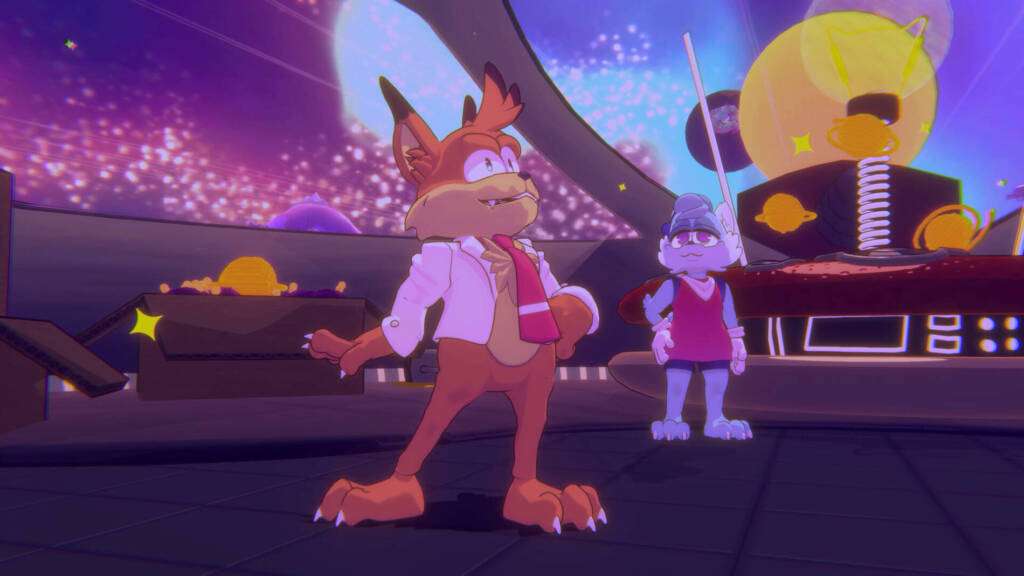
One thing that the former Bubsy titles always did to stand out from the crowd was to ramp up the charm. Even the most frustrating fall was often undercut by the hilarity of the death animation. Fabraz has certainly kept that concept close when designing 4D, and it shows. The Bubsy character is the best he’s ever been: wise-cracking, fourth-wall breaking, and full of bad jokes, but also with a sense of self-awareness about his place in the world as an aging mascot out for one last ride. The cast of characters he rides with on his journey are equally charming, from the delightfully nihilistic Terri and her goofy brother Terry to unrequited love interest Oblivia. Each one appears in every stage to stop and talk to for some entertaining dialogue, and they all have new things to say to you after every new world in the hub, too. Sean Chiplock crushes it as Bubsy, clearly having a lot of fun with the bobcat’s bombastic attitude, and the rest of the voice cast stacks up as well. Plus, a handful of beloved YouTubers were featured as the voices of various BaaBots, which is fun.
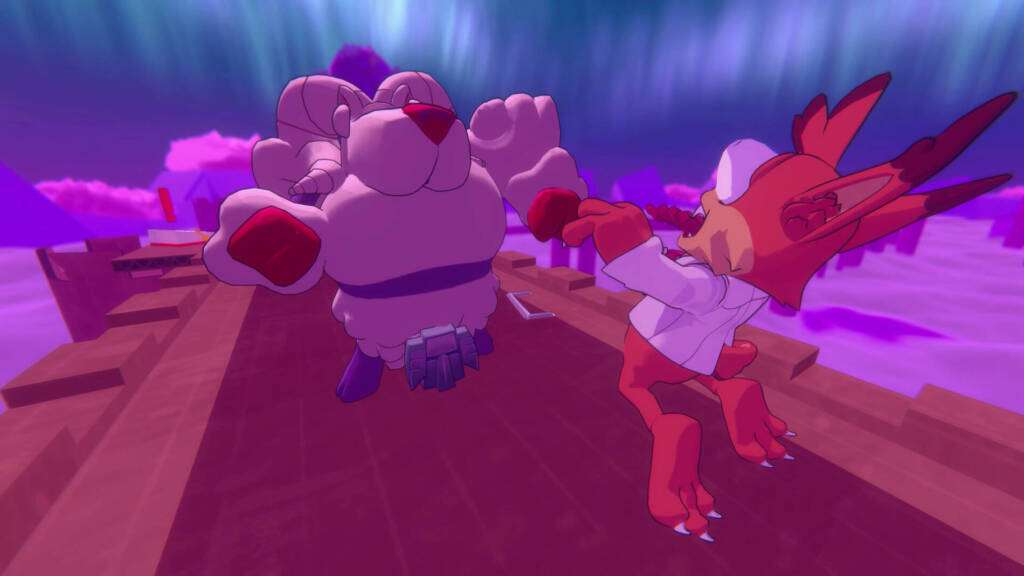
What is a BaaBot, you might ask? Well, that would require us to delve into the game’s narrative, which is honestly quite underwhelming at best, and somewhat problematic at worst. The general narrative, which is explained over the course of about two minutes of cutscene at the beginning, is that series regular villains, the Woolies, abducted large numbers of sheep from our world and experimented on them to create the supercharged, technologically-merged BaaBots. The BaaBots then overthrew the Woolies and have, in turn, oppressed them, forcing them to leave on weirdly themed planets. Also the BaaBots came back to steal the Golden Fleece, the macguffin from the 2017 game The Woolies Strike Back that otherwise goes without recognition by the game at large. It’s just all very nonsensical, and if any genre of game can be narrative-light and get away with it on good gameplay, it’s a platformer. Even so, it feels almost frustratingly undercooked, especially when the closest thing to an actual theme they could land on was oppression, but specifically the oppression of the Woolie oppressors. It’s not like the game has anything real to say on the matter, of course, the team just wanted to use non-Woolie enemy types as well. Even so, it is a strange choice to portray a species that kidnapped another as being the victims when that kidnapped people rises up against them.
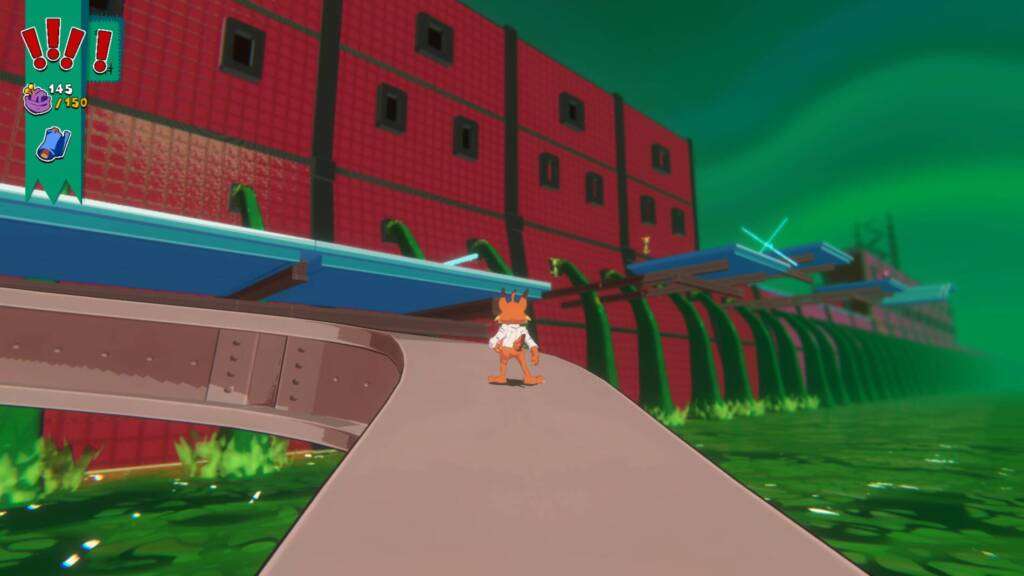
The worlds themselves are a great case of both the game’s strong and weak points when it comes to visual/aesthetic design and general charm. All of them are fantastic-looking, with each planet having a particular theme (more or less) that it (more or less) adheres to. The wool planet and paper planet, especially, feel like they were particularly inspired in design. Each one turns the odd theme into a veritable world: the first world sees you zipping across wool and lace highways, and the second has you venturing into a mazelike cardboard castle that perfectly adhere to the theme. Then we get to the third planet. Despite being called Metalurgia, it is, explicitly, a trash-themed world. Even then, an outsized portion of the trash is specifically relegated to computer parts, and even then, a number of the floating platforms you end up leaping on in the later stages are little more than textured pieces of geometry. One wonders if time constraints crept up here, because Metalurgia feels completely without cohesion, especially compared to the first two worlds. Furthermore, the worlds themselves offer no real throughline or sense of progression from one to the next. There’s no particular reason we go from Wooltopia to Craftus to Metalurgia, other than that’s the way the developers set up the stages for us. It’s disappointing, but would be much more so if the narrative were otherwise interesting, which it isn’t.
Final Thoughts
There’s a whole lot to love about Bubsy 4D, but it’s far from a perfect game, too. It’s a tightly developed, mechanically-precise platformer, which is exactly what you want a platformer to be. It’s also extremely short, with only 15 stages across three worlds, with little in the way of replayability outside of shooting for speedrun records. It also comes complete with timers and leaderboards to support those very speedrunners, too. It has a messy, useless narrative and a lack of cohesion between worlds, and couldn’t even keep a strong cohesive theme for its final world on top of that. On a purely aesthetic level, those worlds all look fanciful and perfect in presentation and coloration for an all-ages platformer.
For every solid decision this game makes, there is an equally baffling decision in another place. And yet, Bubsy 4D still offers more than a simple equation can provide in terms of quality, all coming together to form a very fun little platformer that doesn’t ask for much from you either monetarily or skill-intensively. I get the impression that Atari and Fabraz had a pretty concise idea of what they wanted to make, and maybe didn’t quite have the time to let it all cook properly, but what came out was something I had a pretty darn good time with.